Using ATrack to Measure Your Child’s Progress in ABA Therapy

Watching your child learn new skills, communicate more effectively, build independence, and navigate everyday situations can be one of the most meaningful parts of ABA Therapy in Indiana.
But families often have an important question:
How do I know if my child is actually making progress in ABA therapy?
At Applied Behavioral Consultants LLC, progress is measured through ongoing clinical data, individualized treatment goals, and regular review by your child’s clinical team.
We use ATrack, a comprehensive ABA data collection and practice management platform, to securely collect, manage, and monitor clinical data throughout the course of treatment.
ATrack helps our clinical team document therapy sessions, measure progress toward individualized goals, analyze treatment data, and make informed clinical decisions based on each child’s unique needs.
Better data. Better insights. Better-informed care.
Turning ABA therapy goals into measurable progress
Every child begins ABA therapy with their own strengths, challenges, abilities, and support needs.
Before treatment begins, a Board Certified Behavior Analyst® (BCBA®) completes an assessment to better understand your child’s current skills and identify areas where additional support may be beneficial.
Based on this assessment and collaboration with the family, the BCBA develops an individualized treatment plan with goals designed around your child’s specific needs.
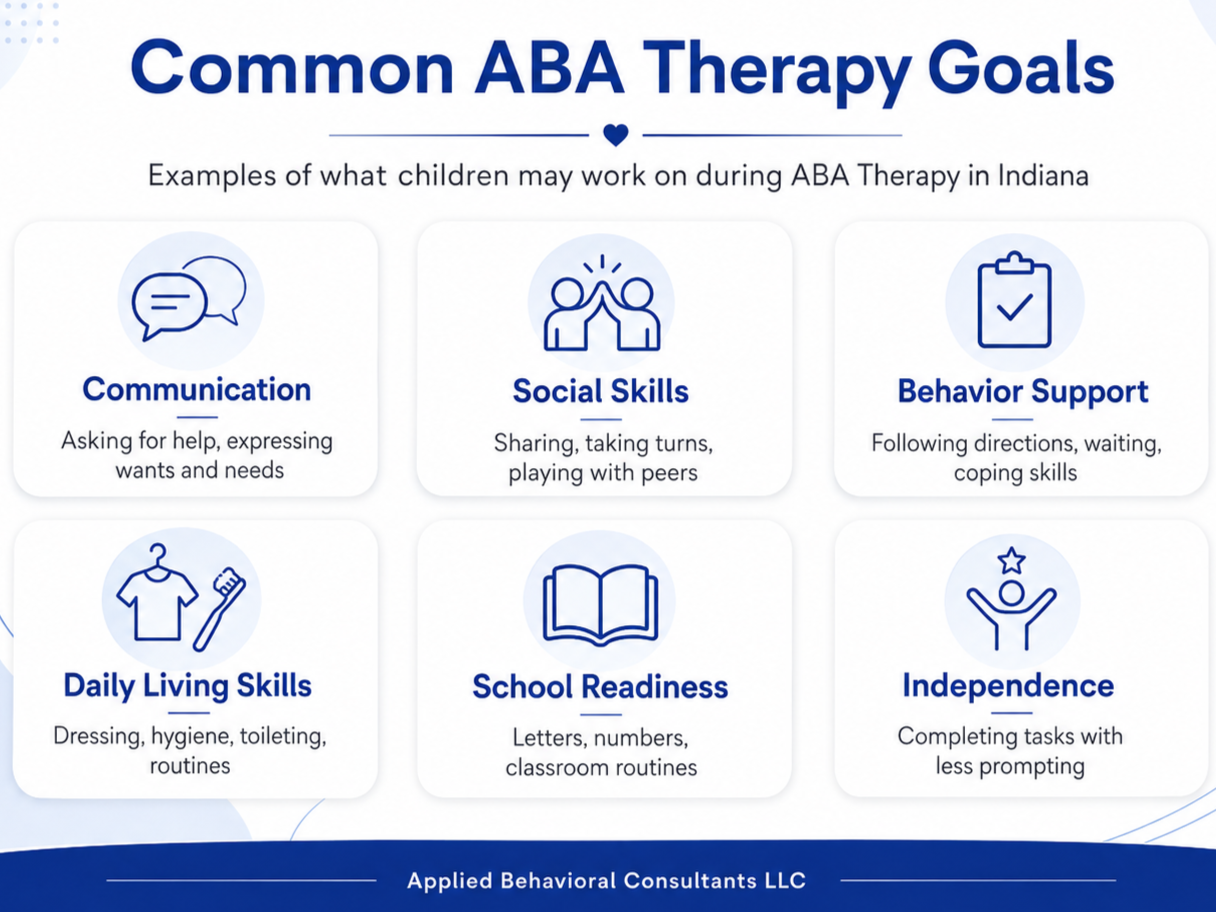
ABA therapy goals may focus on areas such as:
Communication: requesting help, expressing wants and needs, labeling objects, or developing conversational skills
Social skills: sharing, taking turns, playing with peers, responding to others, or participating in group activities
Behavior support: following directions, waiting, transitioning between activities, and developing coping skills
Daily living skills: dressing, eating, hygiene, toileting, and completing everyday routines
School readiness: following classroom routines, completing tasks, identifying letters or numbers, and participating in group activities
Independence: completing age-appropriate tasks with less assistance or prompting
Because every child is different, ABA therapy goals should be individualized to the needs of that child and family.
ATrack helps our clinical team monitor progress toward these goals throughout treatment.
How ATrack supports ABA therapy progress tracking
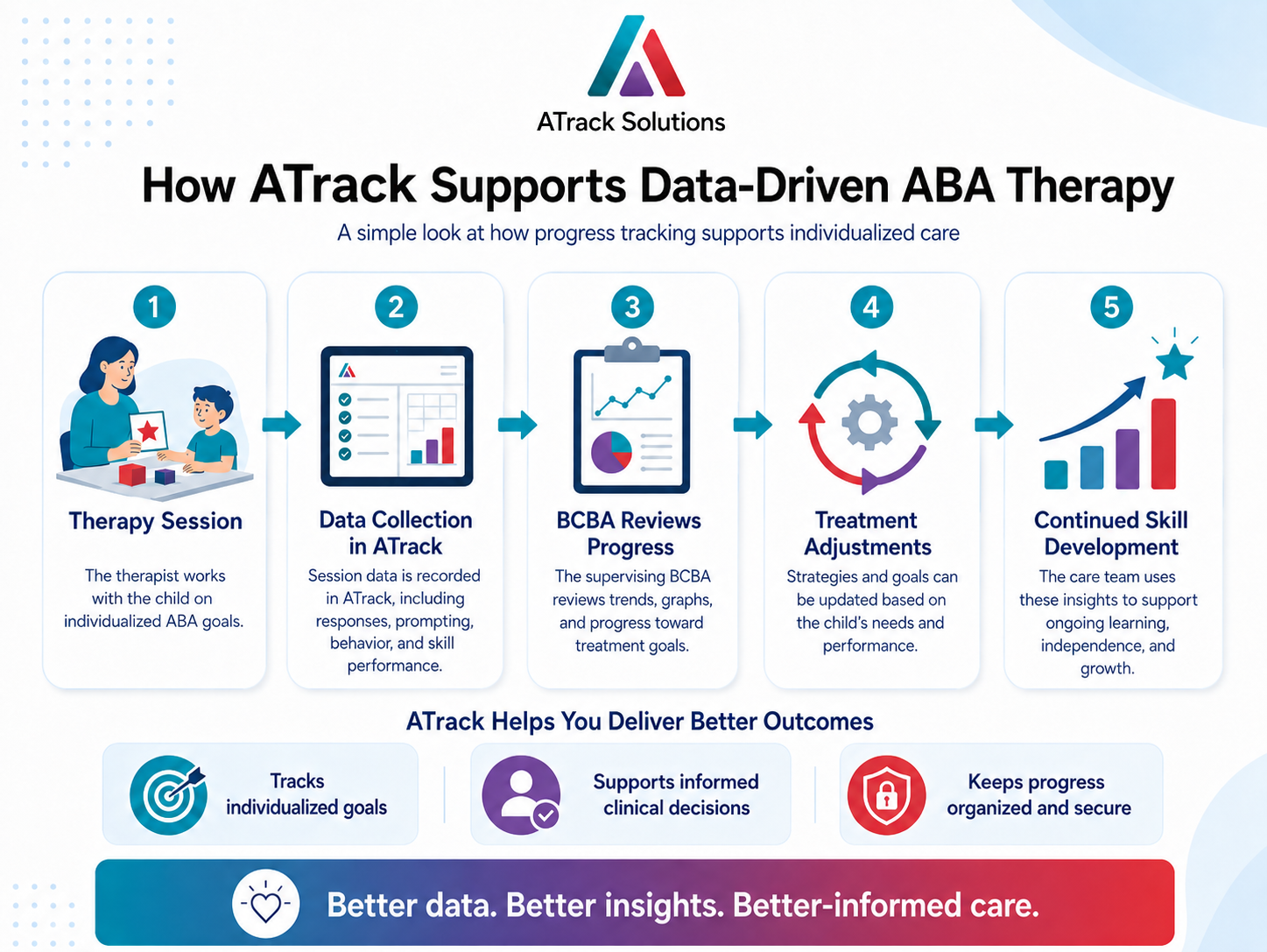
ABA therapy is a data-driven approach to treatment.
During therapy sessions, Registered Behavior Technicians® (RBTs®) and other members of the clinical team collect information about how a child responds during activities, learning opportunities, and everyday situations.
ATrack provides our clinicians with one centralized platform for securely documenting and organizing this information.
Depending on the child’s individualized treatment goals, the clinical team may track:
Responses during skill-building activities
Levels of prompting or assistance
Independent responses
Frequency of specific behaviors
Duration of behaviors
Progress toward skill mastery
Changes in performance over time
Whether skills are being demonstrated across different situations or environments
By maintaining accurate and organized clinical data, our team can better understand how a child is progressing and whether current treatment strategies are producing meaningful results.
Real-time data collection during ABA Therapy in Indiana
Progress in ABA therapy happens one interaction at a time.
During a session, an RBT may work with a child on communication, social interaction, daily living skills, school readiness, behavior support, or other individualized goals.
ATrack allows members of the clinical team to document treatment data as therapy occurs.
This ongoing data collection gives the supervising BCBA important information about how the child is learning and responding to treatment.
Rather than relying only on observations or impressions, the BCBA can evaluate measurable patterns in the child’s performance.
The data can help answer important clinical questions such as:
Is the child becoming more independent?
Is less prompting needed?
Is a new skill being demonstrated more consistently?
Is a behavior changing over time?
Is the child using a skill with different people or in different settings?
Does the current treatment strategy need to be adjusted?
For families receiving ABA Therapy in Indiana, this data-driven approach helps ensure that treatment remains focused on measurable, individualized progress.
Using ATrack data to guide ABA treatment decisions
An ABA treatment plan is not meant to remain exactly the same throughout therapy.
Children learn, develop new abilities, encounter new situations, and may need different types of support over time.
ATrack enables our clinical team to review treatment data and evaluate how well current strategies are working.
If a child is making strong progress toward a goal, the BCBA may introduce a more advanced skill.
If progress has slowed, the BCBA can review the available data and determine whether an adjustment may be appropriate.
Changes may include modifying a teaching strategy, adjusting prompting levels, creating additional practice opportunities, or breaking a larger skill into smaller, more manageable steps.
This process helps ensure that treatment decisions are informed by each child’s actual clinical data.
What does progress in ABA therapy look like?
Progress does not always happen in dramatic leaps.
Some of the most meaningful changes begin with small improvements that gradually make everyday life easier.
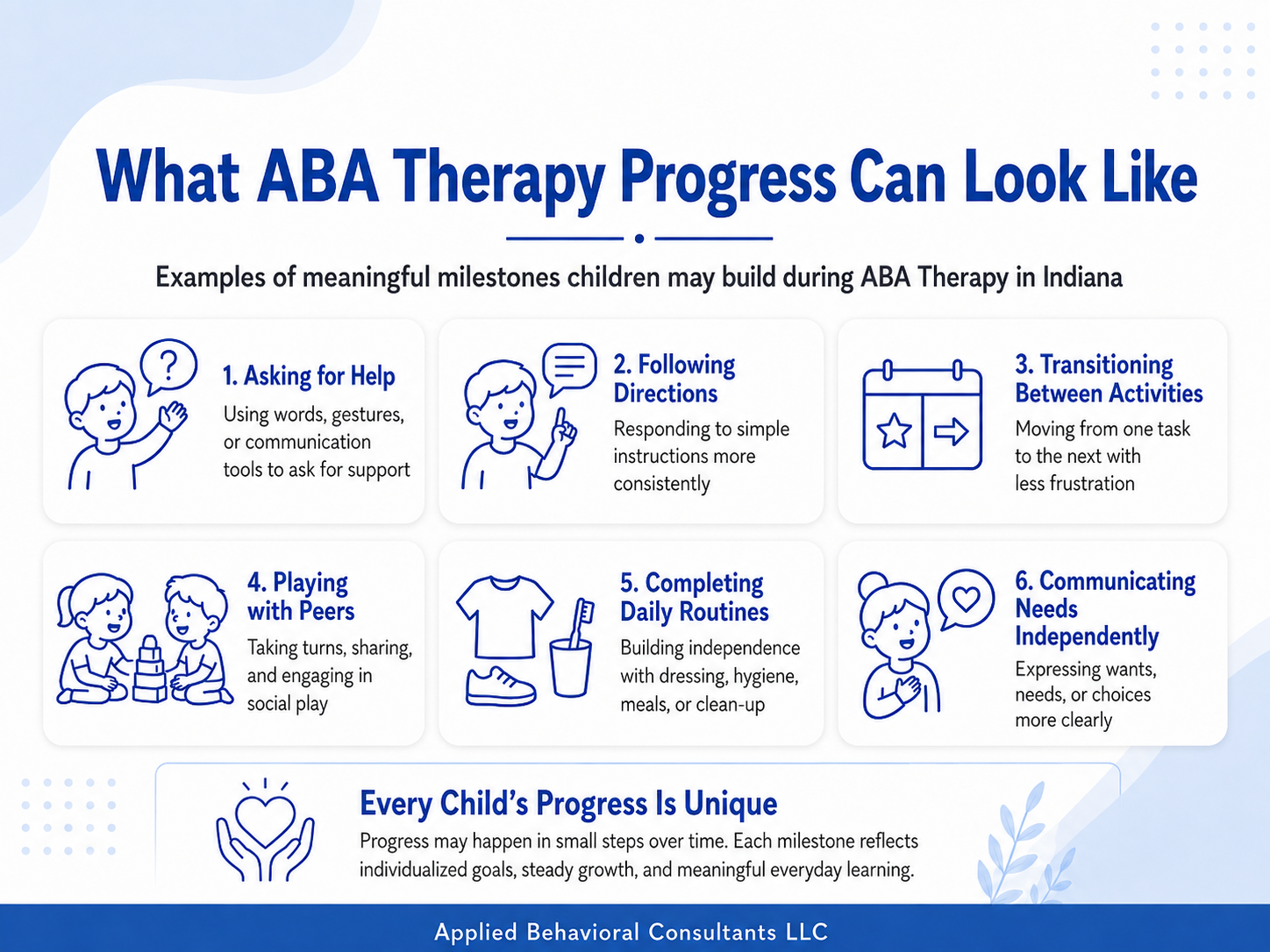
For one child, progress may mean learning to ask for help rather than becoming frustrated.
For another, it may mean completing part of a morning routine more independently.
Progress may also look like:
Waiting for a preferred activity
Following a classroom direction
Playing alongside or interacting with another child
Communicating wants and needs
Transitioning between activities more successfully
Participating in family routines
Completing self-care activities with less assistance
Using a newly learned skill outside of therapy
These individual milestones can build toward greater communication, participation, independence, and confidence over time.
Visualizing ABA therapy progress over time
Individual data points are helpful, but patterns over time can provide an even clearer picture of a child’s progress.
ATrack allows clinical teams to organize and analyze treatment data across different goals and periods of treatment.
Looking at these trends helps BCBAs determine whether:
A skill is improving
Progress has remained consistent
Additional support may be needed
A goal has been mastered
A treatment strategy should be adjusted
A new goal may be appropriate
Tracking progress over time is especially important because development is not always linear.
A child may progress quickly in one area while needing additional time and practice in another.
Ongoing data gives clinicians a broader view of development rather than evaluating treatment based on one successful or challenging session.
Helping our clinical team stay focused on care
ABA therapy involves extensive clinical documentation.
ATrack helps keep treatment information organized within one secure platform, allowing clinicians to efficiently document sessions, review progress, and access information needed to support treatment planning.
Accurate and organized data also supports collaboration among the professionals involved in a child’s treatment.
RBTs, BCBAs, and other members of the clinical team can remain aligned on current goals, treatment strategies, and progress.
This allows technology to support the clinical process while keeping the focus where it belongs: on the individual child receiving care.
Secure management of ABA therapy data
Clinical records contain sensitive information about a child’s treatment and development.
Protecting this information is a priority at Applied Behavioral Consultants LLC.
ATrack provides a secure environment for managing sensitive clinical information and helps our team maintain the confidentiality, integrity, and accessibility of treatment data while following established privacy and security practices.
Secure and organized data management helps clinicians access the information needed to make informed treatment decisions while supporting the protection of client information.
Families are an important part of ABA therapy progress
Clinical data is one important part of understanding a child’s development.
Families also provide valuable insight into what happens outside of therapy, including changes at home, at school, and in the community.
Parents and caregivers should feel comfortable asking questions about treatment, discussing progress, and sharing observations with their child’s BCBA.
Family collaboration may include conversations about:
Current treatment goals
Skills that are improving
Areas that remain challenging
Strategies that can be practiced at home
Changes in routines or behavior
New family priorities
Skills the child is beginning to use outside of therapy
When families and clinicians work together, children have more opportunities to practice and use important skills throughout everyday life.
How often are ABA therapy goals reviewed?
ABA treatment goals are reviewed regularly by the supervising BCBA.
As a child learns new skills or develops new needs, treatment goals may be modified, expanded, replaced, or introduced.
For example, a child may initially work on requesting a preferred item.
Once that skill becomes more consistent, treatment may advance toward making more complex requests, initiating communication, answering questions, or using communication skills with different people and in different settings.
ATrack helps the clinical team monitor these changes over time and maintain an organized record of treatment progress.
How can parents tell if ABA therapy is working?
Parents should understand what their child is working on and how progress is being measured.
Helpful questions to ask your child’s ABA treatment team include:
What goals is my child currently working toward?
Which skills are improving?
How is progress being measured?
Has my child mastered any recent goals?
Are there areas where progress has been slower?
What goals may come next?
What can we practice at home?
Is my child using newly learned skills in other environments?
A quality ABA program should be able to explain what your child is learning, why those goals are meaningful, and how the clinical team is measuring progress.
Data-driven ABA Therapy in Indiana
At Applied Behavioral Consultants LLC, we believe quality ABA Therapy in Indiana should be individualized, measurable, and responsive to each child’s needs.
Our clinical teams use ATrack to securely collect and organize treatment data, monitor progress toward individualized goals, and support informed clinical decision-making throughout the course of care.
Technology does not replace clinical expertise.
Instead, ATrack gives our BCBAs and RBTs access to organized treatment data that can help them identify patterns, evaluate progress, and make informed decisions about treatment.
Every child’s progress will look different.
For one child, progress may mean communicating a need independently.
For another, it may mean participating in a classroom routine, interacting with a peer, completing a daily task, or navigating a difficult transition with greater independence.
By combining individualized ABA therapy, ongoing clinical oversight, family collaboration, and reliable treatment data, our team can remain focused on the outcomes that matter most for each child.
Better data. Better insights. Better-informed care.
Looking for ABA Therapy in Indiana?
If your child has been diagnosed with autism spectrum disorder and your family is exploring ABA Therapy in Indiana, Applied Behavioral Consultants LLC can help you understand what the next steps may look like.
Our team can answer questions about ABA therapy, explain the assessment and treatment process, and help you determine which services may be appropriate for your child’s needs.
Contact Applied Behavioral Consultants LLC today to learn more about ABA Therapy in Indiana and getting started with services.